Executive Summary
Sabre Corporation stands at a critical inflexion point as it balances financial recovery, operational transformation, and emerging shareholder pressure. Following the adoption of a limited-duration shareholder rights plan in response to Constellation Software’s 9.7% stake, Sabre is navigating stabilised revenue, returning profitability, and workforce restructuring aimed at a lean, cloud-native, AI-enabled operating model. Its flagship SabreMosaic platform offers airlines a modular path to modern retailing, yet scalable adoption and sustained investment remain key competitive challenges against rivals such as Amadeus and modular technology entrants. With potential governance shifts, ongoing capital priorities, and migration risks, the next twelve months will determine whether Sabre consolidates as an independent technology leader or enters a new phase of ownership transition—an outcome with significant implications for airlines and the broader global travel ecosystem.
Sabre Corporation: At a Crossroads of Transformation and Shareholder Pressure
Sabre Corporation adopted a limited-duration shareholder rights plan — commonly referred to as a “poison pill” — following the accumulation of a significant economic position by Constellation Software Inc. The move, disclosed in a company press release and accompanying SEC filing, marks a consequential moment for one of global aviation’s most systemically important technology providers.
The rights plan followed Sabre’s full-year 2025 earnings release, which outlined financial progress but also reaffirmed the structural challenges that have defined its post-pandemic recovery. For airlines reliant on Sabre’s Passenger Service System (PSS) and for travel sellers navigating the transition to modern airline retailing, the question is no longer simply about earnings momentum. It is about long-term ownership stability and product investment capacity.
Financial Recovery — With Constraints
Sabre’s 2025 results reflected measurable improvement. Revenue stabilised relative to prior years, and management reported a return to GAAP profitability, supported in part by cost restructuring and the divestiture of its Hospitality Solutions business. The sale, previously announced in 2024, generated approximately $1.1 billion in gross proceeds, enabling debt reduction and improved liquidity.
Adjusted EBITDA improved materially compared with 2024, when Sabre reported $517 million in adjusted EBITDA on $3.03 billion of revenue, with margin expansion of roughly 550 basis points year-on-year. Management has emphasised that deleveraging and operational discipline remain central priorities.
At year-end 2025, Sabre held approximately $910 million in cash and equivalents, though a portion was restricted for near-term debt obligations. The company has extended a substantial share of its debt maturities to 2029 and beyond, reducing immediate refinancing risk. Net leverage has declined from pandemic-era peaks, but absolute debt levels remain significant relative to operating cash flow.
Guidance for 2026 points to mid-single-digit growth in air distribution volumes and a moderation in adjusted EBITDA compared with prior aspirational targets. Investors will likely focus on free cash flow sustainability and continued balance-sheet repair.
The financial narrative, in short, is one of progress — but not yet of structural strength.
Workforce Restructuring and Operating Model Reset
Since 2023, Sabre has undertaken substantial workforce reductions as part of a broader restructuring initiative. In May 2023, CEO Kurt Ekert announced the elimination of approximately 1,100 roles — around 15% of the workforce at the time — targeting $200 million in annualised savings. Subsequent reductions have occurred across multiple global locations.
Management has framed the restructuring as a transition toward a leaner, cloud-native operating model, with increased reliance on automation, offshore development centres, and AI-driven productivity tools. In early 2026, Sabre described a $65 million investment intended to accelerate its shift toward becoming what it terms an “AI-native” technology organisation.
For a company migrating core systems to Google Cloud and building modular retailing capabilities under the SabreMosaic banner, such cost realignment is strategically coherent. However, for airline customers operating mission-critical PSS infrastructure, workforce contraction raises practical questions about implementation capacity, support resilience, and institutional knowledge retention.
Large-scale airline system migrations are among the most complex technology projects in commercial aviation. Vendor stability — both financial and human — is a material factor in long-term contract decisions.
The Competitive Landscape: Amadeus and Beyond
Sabre’s IT Solutions segment, which includes SabreSonic PSS and airline technology services, has faced headwinds in recent years, including airline de-migrations. Vietnam Airlines’ previously announced transition to Amadeus Altéa was among the more prominent examples.
Amadeus, for its part, allocated approximately €1.4 billion to research and development in 2024, underscoring the scale of its ongoing platform investment. By comparison, Sabre’s capitalised technology expenditures were materially lower. While development approaches differ — cloud-native architectures often require less capitalised spend than legacy monolithic systems — the investment gap remains notable.
At the same time, Amadeus’s Nevio offer-and-order platform is still in early-stage rollout, and large-scale PSS transitions remain operationally complex and high-risk. Airlines evaluating technology roadmaps continue to weigh not only feature sets but also execution track records and migration risk.
Beyond the two incumbents, competition is intensifying. Accelya’s FLX ONE platform, PROS’ revenue optimisation tools, and FLYR’s AI-driven pricing solutions offer modular alternatives that can sit alongside, or partially displace, traditional PSS functionality. The PSS market itself, valued at nearly $12 billion in 2025 by industry analysts, is projected to grow strongly as airlines modernise retailing infrastructure.
Sabre’s competitive position, therefore, hinges not only on financial repair but on credible product execution.
SabreMosaic and the Retailing Transition
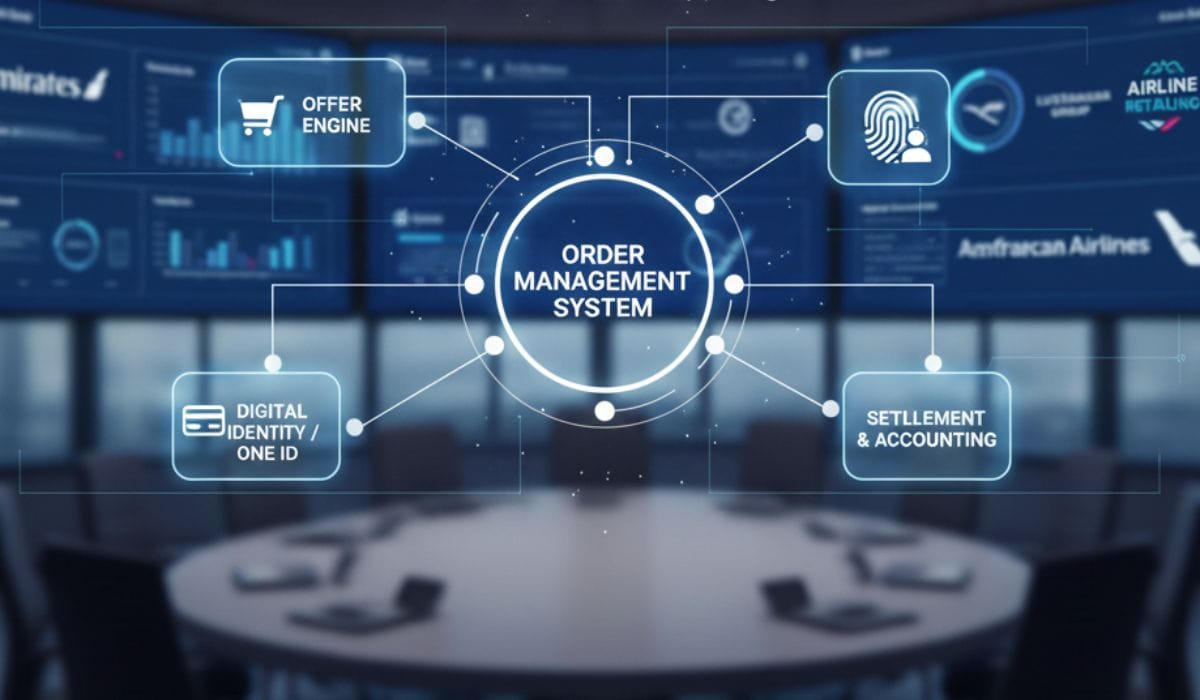
Sabre’s principal strategic initiative is SabreMosaic — its cloud-based, modular retailing architecture developed in partnership with Google Cloud. The platform is designed to enable airlines to transition from legacy PNR-based processes to Offer and Order commerce without requiring immediate full-stack PSS replacement.
Sabre has stated in press materials that SabreMosaic aggregates NDC content from dozens of airlines and supports AI-powered retailing tools such as Air Price IQ and Ancillary IQ. Recent announcements include SabreMosaic Cache-powered Intelligent Shopping, positioned as delivering sub-second latency with high alignment to live airline offers, and a three-way collaboration with PayPal and Mindtrip aimed at enabling agentic AI booking experiences.
As with all forward-looking technology claims, execution and airline adoption will determine long-term impact. Early partnerships with carriers, including American Airlines, Air Serbia, and Riyadh Air, signal market interest, but scalable deployment remains the critical test.
For airlines, the attraction of a modular transition path — rather than a wholesale PSS migration — is clear. The question is whether Sabre can sustain the level of product investment required to compete effectively against a larger rival.
The Constellation Factor
Constellation Software’s accumulation of a roughly 9.7% economic interest in Sabre, as disclosed in regulatory filings, introduces a governance variable. Constellation, a highly disciplined acquirer of vertical market software businesses, is known for decentralised operations and strong free cash flow generation across more than 1,000 portfolio companies.
Its operating philosophy emphasises capital efficiency and long-term cash compounding. Whether that model aligns with the investment intensity required of a global travel infrastructure platform is an open question.
Sabre’s rights plan — triggered at a 15% ownership threshold (20% for certain passive investors) — provides the board with time to assess strategic options. The company has stated that the plan is not intended to prevent bona fide acquisition proposals but to ensure that any change in control occurs on terms deemed fair to shareholders.
For airline customers, the key issue is not shareholder mechanics but ownership clarity. Infrastructure vendors benefit from stability. Prolonged uncertainty can influence contract negotiations and renewal decisions.
Three Plausible Paths
From here, three broad outcomes appear plausible:
1. Independent Stabilisation. Sabre continues deleveraging, stabilises IT Solutions revenue, and delivers SabreMosaic at scale. Competition with Amadeus remains balanced, benefiting airlines through vendor choice.
2. Constellation Influence. A negotiated governance arrangement or eventual acquisition could reshape capital allocation priorities. Airlines would need to assess how product roadmaps align with new ownership incentives.
3. Strategic Transaction. While speculative, a sale to a mission-aligned technology or private equity investor could provide capital support for accelerated modernisation — subject to regulatory scrutiny.
At present, Scenario One remains the company’s stated objective.
What Airline CIOs Should Be Asking
What contractual protections exist around roadmap delivery?
How portable is our NDC and retailing stack?
What is the cost and timeline of PSS migration optionality?
How exposed are we to vendor ownership uncertainty?
These are not theoretical considerations. Airline infrastructure cycles span decades; ownership cycles can shift far more quickly.
Conclusion
Sabre stands at an inflexion point. Financial recovery is tangible but incomplete. Workforce restructuring has improved cost discipline while raising operational questions. SabreMosaic presents a credible architectural vision, yet sustained investment will determine competitive durability. And the emergence of an activist shareholder introduces strategic ambiguity at a delicate moment.
For the aviation industry, the stakes extend beyond one company’s share price. Passenger Service Systems and distribution platforms underpin global airline commerce. Stability, execution discipline, and investment continuity are not luxuries — they are prerequisites.
The coming twelve months will determine whether Sabre consolidates its recovery as an independent platform or enters a new phase of ownership transition. Airlines and travel sellers alike will be watching closely.
Sources include Sabre Corporation earnings releases and SEC filings (2024–2026), corporate press announcements regarding SabreMosaic and strategic partnerships, and regulatory disclosures concerning Constellation Software’s shareholding.
References & Further Reading
Wolstonbury — Commercial Aviation Strategy, Delivered with Clarity and Purpose.
Want more analysis like this? Click the ‘Join the Newsletter’ button to receive the next edition.